Introduction
Equipment
Recordings
Other Stuff
Links

In february of 2008 I bought a Motorola LST-5 transceiver on eBay for $350. The Motorola LST-5 is a small lightweight satellite terminal. It can transmit and receiver in the range of 225.000 - 399.995 MHz in both AM and FM. One problem though...it was a non-working model which was why it was so cheap. But I thought that I might be able to get it up and running again. Here you can read a little about the version B and C. To begin with I thought that my LST was the A-model even though the plate on the unit did not say "A".
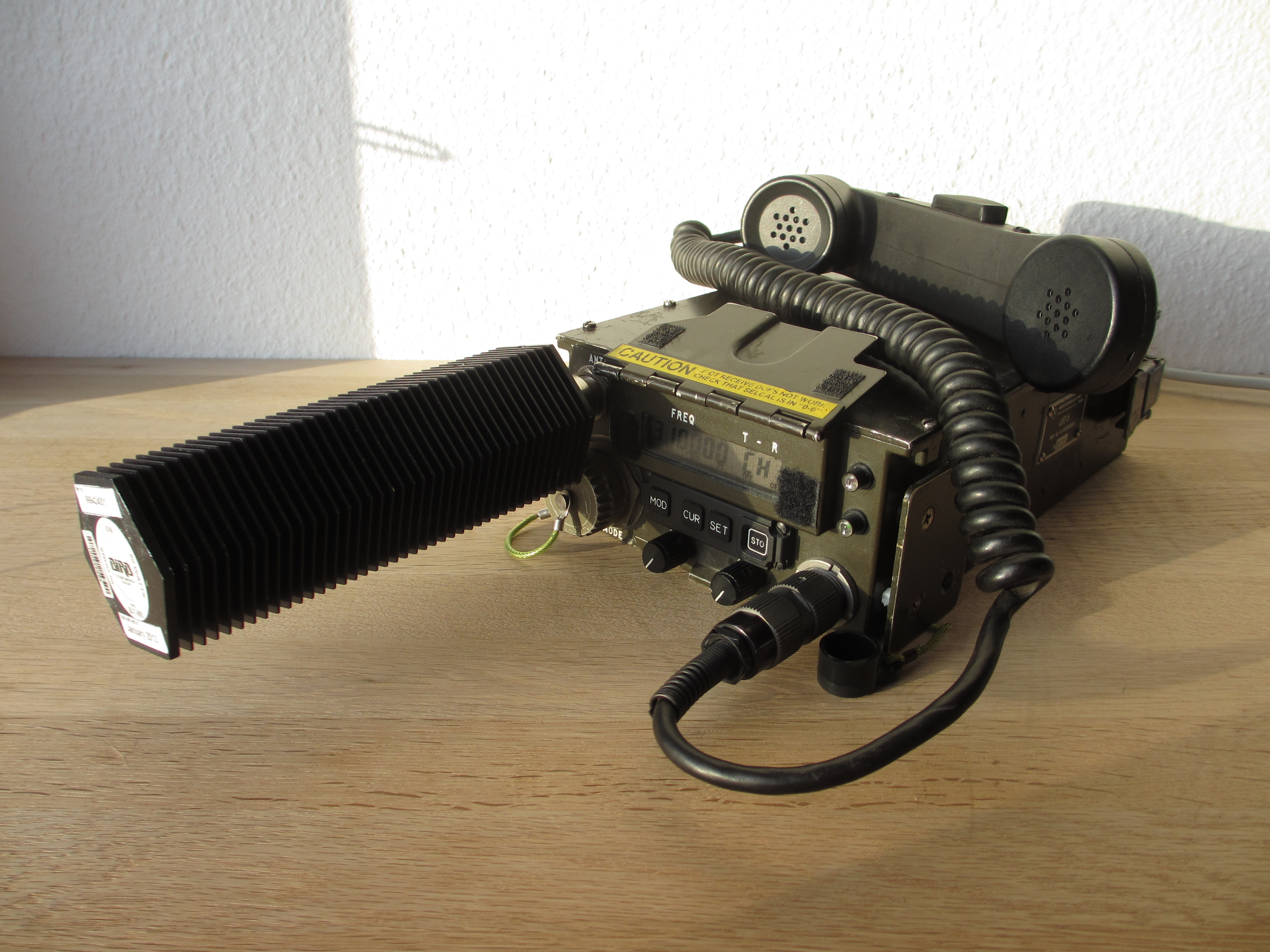
In the following I will try to explain what was wrong (and what is still wrong) with the transceiver. Below I have listed what I have found until now.
2008
First I took a look at the transceiver to see if there were any obvious faults. Inside the transceiver I could see lots of small blue pieces of plastic. It turned out to be a smashed trimmer (R49) on the A3 Audio board as shown below. I have since then found that this trimmer adjust the CT transmit modulation. And since I am not going to use the transmitter part I have decided to mount a new trimmer and focus on other problems.

Powering up the LST-5 I found that it was receiving on 351.000 MHz and the transmitter part was definitely not working. The only possible read-outs on the display are shown below and I was unable to change any settings. So it looked like my LST-5 was set to AM, XHI, PT, SCN and BCN off.
 | 1st display |
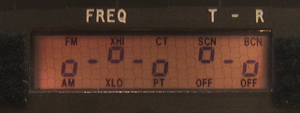 | 2nd display |
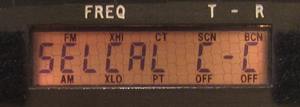 | 3rd display |
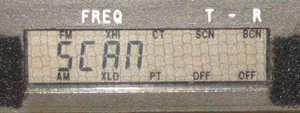 | 4th display |
When the PTT button was pushed it started transmitting on 265.000 MHz and then slowly drifted down towards 210.000 MHz (which is out of the transceivers range). As it reached the end of the drift a clicking noises could be heard in the handset. The amplitude of the transmitted signal varied a lot during this drift and the transmit LED (T) did not light up.
It is difficult to figure out where the problem is without the schematics which I didn't have. Since the A3 Audio board had a chopped off trimmer I decided to find a replacement board. On American Milspec I found a A3 Audio board but replacing it did not help in any way. It was pretty much impossible to get anywhere so I had to "give up" for a while.
2011
One of my many many visitors told me that I could try a "re-boot" of the unit. He told me that I could hold the MOD key down while turning on the power. EUREKA...! Now I'm able to control the transceiver and the read-outs on the display looks much better (see below).
 | 1st display |
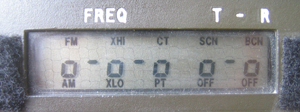 | 2nd display |
 | 3rd display |
I found that the back-up battery on the A2 Processor board was down to about 0.05V and it should be about 3.6V. So I have now replaced this battery and now my LST-5 starts up correctly every time. I can see that it is connected to a MC146818 which is a real time clock and a RAM.
 |
 |
One thing I noticed was the processor board did not look like the processor board in the LST-5A and B version. As can be seen below the A2 Processor board should be two PCB sandwiched together. So I started looking into the part numbers of the boards. It seems like my LST-5 is a preliminary version of the A and B model.
| Model | Motorola P/N. | Info. |
| LST-5 | 01-P25302B001 | I think this is a preliminary version from the early 1980s. |
| LST-5A | 01-P22963H001 | In 1984 the LST-5A was introduced |
| LST-5B | 01-P22963H002 | The B version has a modem and the A version dosen't. |
| LST-5C | 01-P22963H003 | In 1990 this LST-5A was introduced |
| LST-5D | ? | In 1996 the LST-5D was introduced |
| LST-5E | ? | This came in 1992. |
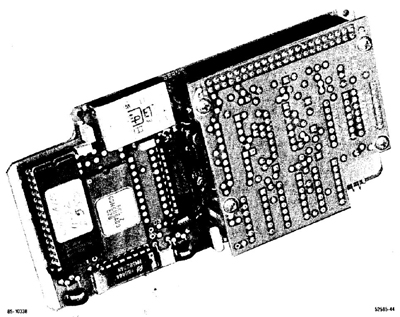
The A2 Processor board in the A and B version has the part number 01-P22956H002. The board in my LST-5 has part number 01-P25320B001. Another thing is that my LST-5 does not have all the menu's. I can only see the frequency, mode, and SELCAL menu's and lag the meter and power adjust menu's.

The transceiver is still not 100% working but I'm closer than I was in 2008. I have confirmed that it is able to receive correctly on some frequencies. I just entered "good old" 255.550 MHz into the transceiver and could hear (see) pirates. I tried transmitting into a dummyload and found that there is a carrier but I can't modulate this carrier. But in beacon mode (BCN) I could hear that the LST-5 was able to modulate the BCN sweep onto the carrier.
2012
I have now found out that the A6 Synthesizer board is not working properly. On the synthesizer board the VCO consists of two oscillators. One is covering the 225.000 MHz to 299.995 MHz and the other is covering 300.000 to 399.995 MHz. When I try to transmit into a dummyload in the range of 225.000 MHz to 299.995 MHz I can see a carrier but in the high region 300.000 MHz to 399.995 MHz nothing happens. I have not made a complete test in receive mode yet. I already know that it can receive on 255.550 MHz so I'm figuring that the low side is working but not the high side.
When I transmit the signal looks like this. The carrier is bouncing around and then locks after half a second. The PLL Lock indicator on the display flashes for 5 seconds after the PTT button has been released. The strange thing is that I can still transmit even though the PLL Lock indicator is flashing. A screendump of the carrier bounce can be seen below.

The next step is checking ALL receive frequencies to see if some of them are not working. The hunt continues...!
...old pictures...
 |
 |
 |
 |